
AI transforms businesses when it:
• executes the repeatable mechanics of operations
• enables humans to make informed, high-quality decisions
This page breaks down back-office operations into the core tasks that consume the majority of time and cost. It helps us differentiate which activities are mechanical, which require expertise, and where AI can execute while humans retain oversight and judgment.
When AI is integrated into systems and workflows rather than used as a side tool, organizations unlock dramatic gains in efficiency, accuracy, and scalability.
This is how AI Infusion™ produces measurable ROI.
For a hypothetical company that has 100 FTEs in the back office, here are the projected improvements by activity type:
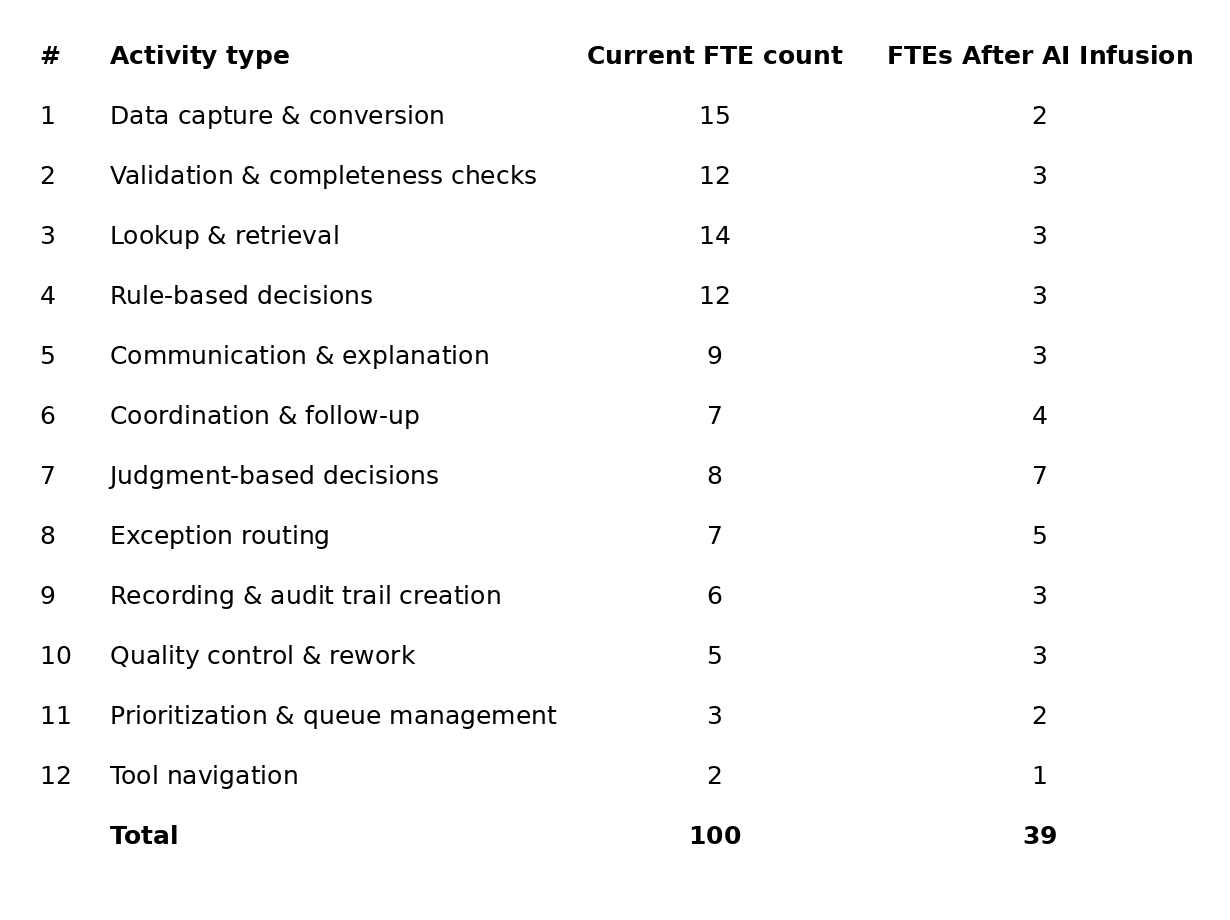
These estimates are based on our experience across multiple real-world engagements in Benefits Administration, Insurance, and Financial Services. Actual results vary by environment, scale, and adoption model.
Let’s take a deeper look at each task type.
What humans do today
Staff receive information from receipts, forms, emails, PDFs, and portals, then manually enter it into structured systems. Their job is to convert unstructured or semi-structured content into standardized fields that downstream processes can use.
Why humans add little value
This activity rarely requires expertise or judgment. The individual is not determining outcomes; they are transcribing, formatting, and mapping information. They are acting as a biological keyboard.
Humans are slow, inconsistent, error-prone and expensive compared to AI at pattern extraction and data mapping.
Why AI fits perfectly
Modern AI is highly effective at recognizing patterns across varied formats and extracting relevant attributes at scale. It can do so instantly, continuously, and with measurable confidence levels.
AI Infusion Pattern
Input arrives → AI extracts and structures the data → systems are updated automatically → humans review only low-confidence or ambiguous cases.
The human role shifts from typing to supervision and exception handling.
What humans do today
Staff need to verify that information is accurate, complete, and consistent before it can be used in downstream processes and to prevent rework and compliance issues.
Typical checks include:
Why humans add little value
These are deterministic checks. Reviewer typically follows checklists/cheatsheets. In most situations, they are not applying discretion or expertise.
Why AI fits
Validation = math + policy. AI is great at both of those.
AI-infused validation can:
Unlike manual review, automated validation scales with volume.
AI Infusion pattern
Validation occurs automatically and in real time, often before the item enters a human work queue. Only cases that fall outside defined tolerance levels are routed to human review.
If a user or employee introduces an error, the system:
What humans do today
Before making a decision, staff must gather the information required to understand the case.
This typically involves navigating across multiple systems to locate:
In many environments, this step consumes a substantial portion of handling time.
Why humans add little value
This is "swivel chair work" - majority of the effort is spent locating information rather than interpreting it.
Employees move between applications and tabs, search records, open documents, and reconcile fragments of data.
The work is logistical. The expertise begins only after the information has been assembled.
Why AI fits
AI systems can retrieve, aggregate, and organize data across platforms in seconds.
They can:
Most importantly, they can present this information in a unified, coherent, contextual format instead of requiring humans to build the picture manually.
AI Infusion pattern
AI automatically compiles a structured briefing. By the time a human engages, they have everything required to work productively and competently.
The search phase disappears. Work begins with understanding, not navigation.
What humans do today
Staff applies predefined policies and criteria to determine the appropriate outcome or next step in a workflow. They evaluate inputs against documented rules drawn from plan documents, regulatory requirements, contracts, employer configurations, and internal procedures.
The objective is consistency: similar situations should lead to similar results.
Most of the effort is spent repeatedly executing logic that has already been defined by the organization.
Why humans add little value
Employee is not exercising independent judgment.They are applying established logic that already exists within the organization. They are doing so mechanically, repeatedly and consistently.
Why AI fits
These decisions are well-structured, based on clearly defined rules (for example IRS publications or Employer configuration document) and system context. AI can make such decisions with very high speed and confidence, while escalating edge cases to humans.
AI Infusion pattern
AI is trained on the approved sources of truth and is integrated into core systems. It performs straight-through processing for standard scenarios.
Cases that fall outside defined parameters, conflict with policy, or present ambiguity are automatically escalated to human experts.
What humans do today
Operational teams spend substantial time translating outcomes, policies, and requirements into messages for participants, employers, and partners.
These communications typically include:
While each case has context, the structure and intent of the communication are often similar across large volumes.
Why humans add little value
In most interactions, the employee is not crafting a novel response.
They are adapting standard language, templates, and policy-driven explanations to fit the situation.
The effort is primarily in assembling and formatting the message rather than determining its substance.
Why AI fits
Generative AI excells at producing clear, structured communication grounded in well-defined rules and clear outcome expectations.
It can:
This allows communication to scale without sacrificing quality.
AI Infusion pattern
AI prepares the response automatically based on the facts of the case and the governing policies.
Humans review, adjust, or intervene when circumstances require empathy, negotiation, or special handling.
What humans do today
They pursue documents, send reminders, and monitor for responses.
For example:
A significant portion of the day is spent waiting, checking, and nudging.
Why humans add little value
Humans are effectively serving as process memory.
The majority of this activity is mechanical rather than expert-driven.
Situations that require negotiation or dispute resolution exist, but they represent the minority of cases.
Why AI fits
AI agents can track commitments, trigger reminders, and escalate automatically.
AI excels at:
Unlike humans, automated systems do not overlook follow-ups or shift priorities based on emotion or distraction.
AI Infusion pattern
AI owns reminders, tracking, and escalation logic. Humans engage only when a response requires interpretation, negotiation, or judgment.
What humans do today
Handle situations where policies, data, or documentation do not produce a clear answer. These cases require interpretation, experience, and responsibility for the final outcome.
Why humans STILL matter
Because this is the point at which accountability and human judgment are essential.
Organizations rely on trained professionals to evaluate gray areas, weigh context, and stand behind the decision.
Where AI helps
AI improves the quality and speed of human judgment by:
AI Infusion pattern
AI prepares, structures, and recommends.
Humans validate, decide, and own the outcome.
What humans do today
Assess incoming issues and determine which queue, team, or specialist should handle them.
Why humans add little value
Routing logic usually depends on identifiable attributes such as product type, dollar value, employer configuration, or regulatory category. This process is largely pattern recognition.
Why AI fits
AI is notoriously good at classification and pattern matching. AI systems can evaluate multiple variables instantly, apply routing logic consistently, and adapt as patterns evolve.
AI Infusion pattern
Cases are automatically directed to the correct destination, with visibility, confidence scoring, and the ability for humans to override when necessary.
What humans do today
Staff create an audit trail describing what actions were taken, what decisions were reached, and the rationale behind them.
Why humans add little value
This work is largely administrative and occurs after processing has already happened.
It is standardized documentation rather than expert contribution.
Why AI fits
AI can automatically capture inputs, rule applications, timestamps, and outcomes at the moment they occur, producing a complete and defensible record in real time.
AI Infusion pattern
Documentation is generated continuously as part of execution, reducing manual effort while improving traceability, consistency, and compliance.
What humans do today
Review completed work to identify errors, reopen cases, and correct issues discovered downstream.
Why humans add little value
Many of these problems originate from predictable validation gaps or missed rules that could have been detected earlier.
Why AI fits
AI can monitor transactions in real time, flag anomalies immediately, and prevent incorrect outcomes before they propagate.
AI Infusion pattern
The organization shifts from repairing defects to preventing them.
What humans do today
Determine which items should be addressed first based on experience, perceived urgency, or static guidelines.
Why humans add little value
Manual prioritization rarely accounts for full context, shifting workloads, or the true economic impact.
Why AI fits
AI can continuously evaluate deadlines, economic benefit, and service commitments, adjusting priorities dynamically.
AI Infusion pattern
Work queues update in real time so effort is always applied where it matters most.
What humans do today
Transfer information between applications, re-enter data, navigate between screens and tabs, and perform the steps required to move work forward.
Why humans add little value
This activity is necessary but mechanical. It consumes time without requiring interpretation or expertise.
Why AI fits
Through integrations, APIs, and automation frameworks, AI can exchange and update information instantly and accurately.
AI Infusion pattern
AI moves data automatically across platforms, and humans engage only when decisions or judgment are required.